When England seized control of the region once known as New Netherland, the land that would become New Jersey passed into the hands of the Duke of York, brother of King Charles II. At first, the Duke treated this territory as a vast personal estate. But in 1664, seeking to reward loyal supporters and encourage settlement, he granted a large portion of this land to two proprietors: Sir George Carteret and Lord John Berkeley.
This grant became the foundation of New Jersey, named in honor of Carteret’s defense of the Isle of Jersey during the English Civil War.
How the Split Happened
Carteret and Berkeley soon realized that governing such a large and diverse territory from across the Atlantic was no simple task. Their interests also differed, and the pressures of managing a new colony — attracting settlers, establishing laws, and resolving land claims — pushed them toward dividing their holdings.
By the early 1670s:
Berkeley, facing financial strain, sold his share to a group of English Quakers.
This sale effectively created a western proprietary region influenced by Quaker ideals of religious tolerance and peaceful governance.
Carteret retained control of the eastern portion, which continued to develop under more traditional English colonial structures.
East Jersey & West Jersey Take Shape
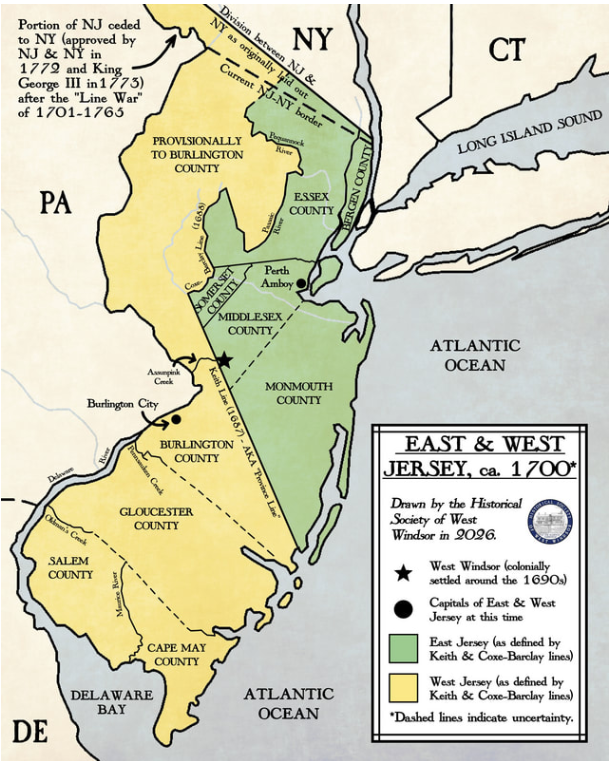
The division became formalized in 1676 with the Quintipartite Deed, which drew a line from Little Egg Harbor northward to the Delaware River. Though the boundary was imperfect and often disputed, it created two distinct provinces:
East Jersey — centered around Perth Amboy, shaped by English, Scottish, and Dutch influences.
West Jersey — centered around Burlington, guided strongly by Quaker principles and some of the earliest expressions of democratic self‑rule in America.
Why This Matters for NJ Coastal Heritage
The East/West Jersey split is more than a colonial footnote — it shaped:
Settlement patterns along the coast and rivers
Religious diversity, especially in West Jersey
Early governance, including some of the most progressive laws in the colonies
Land ownership traditions that still echo in New Jersey’s patchwork of towns and counties
It’s a foundational chapter in how New Jersey’s coastal communities developed their distinct identities — something your platform is perfectly positioned to highlight.